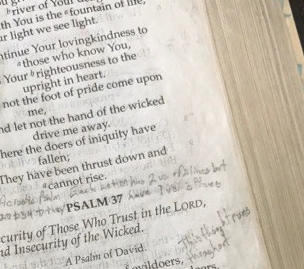
Sermon Prep Fundamentals

I have had classes on preaching.  I have preached now for more than 20 years and I am still trying to become a better preacher.  I have also found that almost no two preachers prepare the same way.  I am not sure there is a right or wrong way to prepare a sermon, but I do believe the fundamentals of preparation must be the same.  I think that the pattern of a faithful sermon is demonstrated in Scripture.  A faithful sermon must explain the text, apply the text to the listener, and point the listener to Jesus.  There are many who merely deliver religious speeches, but if the pattern is ignored it cannot be qualified as a sermon. Continue reading “Sermon Prep Fundamentals”

The Long Book Challenge: Acts Edition

Serving the local church through pulpit ministry is more often than not done through a process of planning.  Many aspects are examined when planning for preaching.  At any given time, I try to take into consideration the state of the church, the needs of the folks, the direction in which I believe God is leading the church, prayer, the calendar, and at times local, state, national and even international events.  The process of planning for preaching must stretch the preacher and serve the congregation faithfully with the goal of teaching the whole counsel of God.  I am committed to expositional preaching.  I believe that God inspired the 66 books of the Bible and the best way I can serve the church is by preaching through books.  I have preached expositional messages on various subjects and doctrines.  I have preached expositional messages through shorter books in both the Old and New Testament but I had never successfully preached through a longer book.  Recently, in about 40 messages, I preached through the entirety of Acts. Continue reading “The Long Book Challenge: Acts Edition”

To My Girls on Adoption Day!

Girls,
Today life seems a little bigger and a lot more designed. Today is a bold reminder that life is bigger than I even imagined. Today marks the end of a struggle and the realization of something far bigger than me. Today the struggles of Foster parenting come to an end; you are finally home. You will never have to be frightened when we pack a bag or when a stranger shows up at our home. You are home. No more brave faces when we drive across town, once and for all you are home. No more will I have to put on a brave face when a stranger drives away with you on a visit, you are home. Today brings with it the assurance that I won’t have to wait by the phone to hear how my life, your life, our life will change because of what seems like the arbitrary decisions of a few strangers. Today, a judge will confirm something bigger, God’s plan. I wasn’t there when you were born. I wasn’t there when you took your first steps or said your first words but today a judge confirms that even then, when I didn’t know you and you didn’t know me, you were my girls. Today marks the end of your struggle of getting to me and the end of my struggle getting to you. Today is the realization that despite all that you have been through, God in His infinite love and wisdom has worked out His plan to bring you home. Today is a reminder that family is bigger than biology and genetics, family is the work of God. The Apostle Paul wrote, “But when the fullness of the time had come, God sent forth His Son, born of a woman, born under the law, to redeem those who are under the law, that we might receive the adoption as sons.” (Galatians 4:4-5). The picture that Paul uses to help his readers understand what happens when a person comes into the family of God is adoption. Adoption is something that is received. I will adopt you today. What happens today it is the realizing of the plan of God from eternity past; you have always been mine. Today I realize that years ago sitting in class hearing my favorite college professor talk about his love for his children (some biological and some adopted); God was bringing you to me, even before you were. I realize that those key conversations standing outside of a Shoney’s or that unexpected conversation with a friend from the past; God was brining you to me. I realize now, looking back, just how intricate that God’s plan truly is and even as there are some things that I cannot explain, “the fullness of time has come”, and you are finally home. Today we all get to see what God has been working since before time began you are my daughters, always have been always will be.

Daddy Continue reading “To My Girls on Adoption Day!”

Broken Leader & Broken Followers

Although a leader must lead every person with value and dignity, a leader must never forget that all people are sinners.  As a personal testimony, the apostle Paul wrote, “For we know that the law is spiritual, but I am carnal, sold under sin.  For what I am doing, I do not understand.  For what I will to do, that I do not practice; but what I hate, that I do.”  (Romans 7:14-15).  People sin because they are sinners.  Being a “sinner” is a state of existence not a description of action.  Even as people have been made in the image of God, they are fallen.  Millard J. Erickson wrote, “The Bible’s depiction of the human race is that it today is actually in an abnormal condition… In a very real sense, the only true human beings were Adam and Eve before the fall, and Jesus.  All the others are twisted, distorted, corrupted samples of humanity.  It is therefore necessary to look at the original human state in Christ if we would correctly assess what it means to be human.”  As a leader, is important to remember that people are to be treated with value and dignity even as they act in contradiction to that value and dignity.  Furthermore, a leader must remember that it will not be his first instinct to treat people with value and dignity but rather because he is a sinner leading sinners he will have a desire to live a life that is self-serving.  The natural tendency for all people, including the leader is to seek their own well-being and to live out their own desires. As stated above, the human existence is a twisted one, deeply marred by sin.  People do not naturally follow leaders, and leaders don’t naturally seek the well-being of others.

A leader must practice the discipline of viewing others as individuals made in the image of God.  The way the leader views people will result in the way he treats people.  In order for a leader to view people correctly and treat people correctly he must submit to God’s leadership.  A leader who submits to God’s leadership will correct his thoughts on all things by the Word of God.  A leader must submit to God’s leadership in how he leads other people.  The apostle Paul wrote, “Let each of you look out not only for his own interest, but also for the interests of others.” (Philippians 2:4).  A genuine leader is not one who functions by his own ability but is one who submits to God’s leadership.  J. Oswald Sanders wrote, “Spiritual leadership requires superior spiritual power, which can never be generated by the self.  There is no such thing as a self-made spiritual leader.  A true leader influences others spiritually only because the Spirit works in and through him to a greater degree than in those he leads.”  A genuine spiritual leader must be one who submits to God’s leadership out of an understanding of dependence that the task of which he has been called is one in which he is truly inadequate.

A leader must live with the awareness of his inadequate view of people apart from God, his inadequate ability to lead people apart from God and his ignorance on where to lead apart from God.  Every leader must live in constant awareness of his sinfulness and inability to lead other people in the tasks that are pleasing to God.  Henry and Richard Blackaby wrote, “The primary purpose of spiritual leaders is not to achieve their goals but to accomplish God’s will… spiritual leaders have a God-given responsibility to do all they can to lead their people on to God’s agenda.”  A genuine spiritual leader is a leader who is dependent on God.  A leader must be willing to submit his ideas, his strategies and his goals to accomplish the will of God.  R. Scott Rodin wrote, “Godly leadership is the miracle of God’s use of our earthen vessels for the glorious work of His kingdom.”  A leader has a task that is greater than himself, it is a task that requires the instruction, direction and power of God to accomplish.  A leader is one who is aware of his personal sinfulness and is dependent on God for a correct view of others and on the power of the Holy Spirit to treat others as Christ would treat them. Continue reading “Broken Leader & Broken Followers”

Leadership & Individual Dignity

There are many definitions of leadership but all of them have a single common denominator, people. Of all the things that are addressed in leadership theory, among all of the applications of leadership principles, they all ultimately involve people. Leadership is about people. The way the leader views other people matters. If a leader has a low view of people, it will be reflected in virtually every area of his leadership. The way a leader views people, in the most difficult situations, that view will be demonstrated in the decisions he makes. Every aspect of the leader is reflected in his view of people. It is on this basis, the individual value and dignity of all people, that a leader must find his mooring. All people, regardless of circumstances, possess indelible value and dignity. The value and dignity of every human life has been ascribed to every person without exception by God Himself. Moses wrote, “God created man in His own image; in the image of God he created him; male and female He created them.” (Genesis 1:27). The value of each person has been ascribed to them by God because of how God created mankind.

God created man in His image. Biblical scholars offer various contributions as to the meaning of being made in the image of God, but what is clear is that this image makes man unique among all of creation. Also, the image of God is directly connected to the reason for man’s existence. Moses wrote, “Then God blessed them, and God said to them, “Be fruitful and multiply; fill the earth and subdue it; have dominion over the fish of the sea, over the birds of the air, and over every living thing that moves on the earth.” (Genesis 1:28). Because God made man in His own image, God instructed man to, “Be fruitful and multiply; fill the earth…” God’s instruction for mankind was to fill the earth with the image of God through reproduction and his position was to subdue creation under the authority given to him by God. Man has been distinguished from animals by God through his position as one created in God’s image. People have been distinguished from animals by God because each person bears the image of God.

Every person is of value and bears individual dignity because they were created in the image of God. Moses wrote, “Whoever sheds man’s blood, by man his blood shall be shed; for in the image of God He made man.” (Genesis 9:6). In this passage, the highest punishment for murder is prescribed by God, death. Murder is punishable by death because every person bears the image of God. Every person bears the image of God and is of the highest value because of the way in which they have been created. All people have been created uniquely by God because every person bears God’s image and a leader must view every person with value and dignity. The image of God is to even affect the way that people speak of one another (James 3:9). People cannot be viewed as a commodity or as a dispensable resource. People are not a means to an end. Henry and Richard Blackaby wrote, “There is a difference between giving God your best and giving God the best. Excellence generally describes tasks, and tasks are usually a means to an end. People are the end. Churches that concentrate more on their tasks than on their people are missing what God considers most important.” The way a leader views people will determine his priorities and the way those priorities are carried out. A leader cannot disconnect the way he views people and the way he leads people. Every person is created in the image of God and every person must be led with value and dignity. Continue reading “Leadership & Individual Dignity”

The Fundamentals of Impact

shoesIt is easy to lose focus on the fundamentals, the building blocks, as we carry out the mission to which God has called us.  Each of us has a mission to which God has called but our daily activity can be like a snow ball, picking up clutter along the way.  In the life of a leader, there is a constant need for the discipline to refocus our lives to ensure that we continue to carry out the mission to which God has called us.  Refocusing maintains the aim of the original mission.

It is easy to lose focus of the fundamentals within pastoral ministry; there are always projects to work on, people to call and lessons to prepare.  In the midst of all of this good work, fundamentals can easily be overlooked.  A leader must maintain the discipline of returning to the fundamentals which are the building blocks of greater things.  The late, great Coach of the UCLA Bruins, John Wooden, was a master at emphasizing the importance of fundamentals.  Wooden wrote, “…on the first day of practice I personally showed players how to put on their sweat socks to prevent blisters…Socks, put on correctly, may prevent a turnover, which in turn may win a game.  What if that game is for the national championship?”  The stakes are much higher in pastoral ministry only the results are not as readily seen as the wins and losses of an athletic competition.  One of the simple fundamentals of pastoral ministry is discipleship.

The pastoral ministry is too important to not personally make disciples.  The calling of God is too great not to personally make disciples.  The Pastoral ministry is too demanding not to practice the discipline of removing the clutter that accumulates with the task and returning to the simple task of putting your socks on correctly and teaching others to put on their socks correctly as well.  A Pastor must be a disciple maker, not just from the pulpit but on an individual basis.  The task of disciple making does not come with fanfare and does not happen with a crowd but it is the way that great men and great churches are built.

Jesus was a disciple maker.  Jesus commanded His disciples not to go but to make disciples, they were already going.  If you make a close study of Jesus’ disciple making process, you will see that He taught His disciples in life, as they were going, not in an institutionalized class.  I was struck by this statement by Warren Wiersbe in my personal time with God.  He wrote, “The older generation must provide for the next generation, not only materially but most of all spiritually. “Senior saints” must be examples of believers and encourage the younger generation to trust the Lord and wholly follow Him.”  Maybe you read these words and as you assess your life you do not see a faith that reproduces a life worth emulating.  If that is the case, please be willing to ask for help.  There is no shame in asking for help, only in failing to grow.  Personal growth takes an investment.

Pastor, wipe away the clutter and begin to pour into someone’s life.  Do you want to see the church of which God has made you a steward to make an impact on your community?  In order to make an impact you must build men, leaders, and disciples to multiply your effort.  Pastor, return to the fundamental task of “…teaching them to observe all things…”  Let’s impact the world for Jesus’ fame! Continue reading “The Fundamentals of Impact”

Blog at WordPress.com.

Up ↑