Some Bible Study Tools that You Probably Didn’t Know Existed

   Studying the Bible can be a daunting task.  Even knowing where to begin in your study can be overwhelming.  There is an entire field of academic study devoted to studying the Bible and many people spend their entire lives studying just a single area of Scripture.  How then is a person who has a family, a job, and countless responsibilities ever going to grow in his relationship with Jesus Christ or become a better student of God’s Word?  You already know that a knowledge of God’s Word is vital to your spiritual growth.  The knowledge is a means to an end, God the Holy Spirit transforms you by His Word.  God has specially called people who have not just devoted their lives so that you would know more about the Bible, but so that you would know the God of the Bible more.  There are countless Bible tools that have been prepared by those who have devoted their lives to help you study the Bible.  Here are some of those tools that you may probably didn’t know existed.

Bible Handbook – A Bible Handbook is kind of like a one stop shop in Bible study.  A Bible Handbook is designed to give you a broad overview of Scripture in a single volume.  In this, you will find introductions to the biblical books, commentaries, charts, maps, and helpful articles presented in a broad and concise way.  A Bible Handbook is designed to be the first place that you go to get your feet wet in your study.  If you are teaching a lesson from an unfamiliar book or passage, a Bible Handbook will help you understand quickly the context and circumstances of the passage’s writing.  This is very valuable for every student of the Bible.  Wilmington’s Bible Handbook and the Holman Bible Handbook are both great examples of this helpful tool.

Different Levels of Commentaries – A Bible Commentary is the teaching of an individual on a book, a division of a book, or even a passage of a book from the Bible.  Not all Bible Commentaries are created equal and they were never meant to be.  Bible Commentaries range from the compilation of notes from a pastor’s sermon to very narrow scholarly works.  They can be very broad, common and approachable, to very narrow, precise and extremely technical. 

    The most technical commentaries are going to be written by people who are experts in their area of study and most often they’re not the most well-known or popular authors.  An expert in this field is going to be someone with credentials from trusted institutions that has actually put in the time to learn his craft.  Although a Pastor can be extremely helpful, imagine the difference between a General Practitioner and a Specialist.  Your General Practitioner is a very educated, skilled professional, but a Specialist has devoted his life to the study of a single area, system or organ of the body.  This is much like the difference between a trained pastor and Bible Scholar.  These scholarly volumes are going to be very narrow, limited to a single book or a single portion or passage of a book and will utilize language that is unfamiliar except to the most serious of students.  These are the types of works that are utilized when doing the most serious of studies and will expose the student to the most minute details.  Some examples of these scholarly commentaries are: The New International Commentary on the Old Testament; The New International Commentary on the New Testament; The New American Commentary; The Expositor’s Bible Commentary

    Maybe you desire to more deeply study God’s Word but you are just getting started.  You are going to want to look at reliable yet approachable commentaries.  I didn’t really start to follow Jesus until I was around 18 years old, and I knew very little about the Bible.  Although I knew very little about the Bible, I had a great desire to learn.  I happened upon a two-volume set of commentaries, the Liberty Annotated Bible Commentary (Now Published as the King James Bible Commentary).  These commentaries were originally published by the Religion faculty of Liberty University and were written with the layman in mind.  I devoured those commentaries.  I trusted the authors, many of them were my college professors and I could understand what they wrote.  I spent five hours a day reading these commentaries and I learned so much and believe that God used these commentaries to grow me immensely.  These commentaries are helpful for the beginning Bible student or to give the reader a very basic understanding of the passage.  Some examples of these layman commentaries are: The King James Bible Commentary; The Bible Knowledge Commentary; Matthew Henry’s Commentary; Warren Wiersbe’s “Be” series

    The final area of commentaries are those pastoral sermons that have been turned into commentaries.  These commentaries are usually a bound sermon series.  They are helpful for light study and devotional purposes.  These commentaries are usually published by well known preachers who are engaging and popular.  These popular works, which makeup much or what is read among Christians today, have their place but as believers we must keep growing.  Placing such works in this category is not a criticism of their work or skill, it’s a recognition of who they are and their intent.  Some of the greatest pastors the world has ever known would fit in this category.  Some examples of popular commentaries are going to come from men like: Charles H. Spurgeon; Oliver B. Greene; Charles R. Swindoll; John MacArthur. 

Outline Bibles – An outline Bible rarely contains the text of the Bible but rather is an outline of a book or in some cases the entire Bible.  These Bibles are helpful in understanding what, in the opinion of the writer, the biblical author was saying.  Remember, the biblical author is not writing at random, he has a line of thought.  An outline Bible is meant to trace the biblical author’s line of thought.  These are helpful in understanding a biblical passage in a flash.  A great example of an Outline Bible is Harold Willmington’s Outline Bible.   

Bible Guides – There is a name that has appeared in many of the aforementioned examples, Harold L. Willmington.  He is a man that many today do not recognize but he was a gift to the average person who wanted to study the Bible more deeply.  Dr. Willmington who was known as Mr. Bible, equipped countless men and women with a foundational education in God’s Word be it through his Bible Institute or his Willmington’s Guide to the Bible.  His guide is a Bible education in a single volume.  It comes in digital or a large green and gold binding that contains multiple reading approaches, outlines and theological teachings that will equip the reader in becoming acquainted with the Bible. 

There are so many more tools for Bible study that I could have listed here, but the above are some tools that most don’t realize exist.  I would challenge you to purchase some of these tools for your own study.  Remember, the goal is not to know more Bible facts, but to become a better student of the Bible, to become better acquainted with its author.     

Getting to Know Your Study Bible

    Growing up as a kid, my dad had all kinds of different tools.  My dad has always been the type of guy who had the incredible ability to fix almost anything.  It was always exciting to see him diagnose a problem and put all of those tools to work.  Tools are something that you grow accustomed too, but when it was time to get my own tools, it was almost impossible to get an exact duplicate of his tools, especially his voltmeter.  Dad’s voltmeter was simple, straightforward and to the point.  When I purchased my voltmeter, it had symbols and functions that require their own education.  To be honest, I have owned my voltmeter for years and still am not sure what all it does.  For many, your study bible is exactly the same way.  You have owned it for years and are still not sure what all it does.

    A Study Bible is a tool.  It was designed to help you more effectively study God’s Word.  It is filled with features that allow you to study the Bible on your own in order to grow in your faith.  Study Bibles come in all kinds of different translations, publishers, editors and even with different focuses.  Each have features that are unique, but most have some general features that common among all.

Articles – Although there are a many different kinds of Study Bibles, many have articles that have been contributed by authors to help you grow in your faith.  I have many different Study Bibles, some have a devotional focus and others have a more serious focus.  Generally, there is a list of these articles somewhere in your Bible.  You may find it helpful to allow yourself time in your study to read these articles as you study, or you may commit yourself to reading an article a day.  They have been designed to help you deepen your knowledge of the Bible and ultimately help you grow in your faith.

Maps – Almost every Bible includes maps.  These maps will help you trace the movement of the characters of Scripture.  You will find that there are maps tracing the division of the land in the Old Testament.  There are maps that display the change of the land of Israel from the Old Testament and the New Testament.  There are even maps that help you follow the different missionary journeys of the Apostle Paul.  Maps will help you understand Scripture more fully and serve to bring the stories to life.

Cross References – Scattered throughout verses in your Bible you may find little letters, or numbers that coincide with a collection of verses on the page.  These clusters of verses are almost always cross references. The greatest commentary for the Bible is the Bible.  It is helpful to understand the passages that are more difficult to understand with the passages that you understand clearly.  It is important to point out that not all clusters of verses are general cross references but are study systems that are designed to walk you through preselected subjects.  Cross references can help you gain insight into passages of Scripture and expose you to more of the Bible itself.

Book Introductions – Study Bibles most often come with book introductions.  These introductions are designed to help you become more acquainted with the book before you actually read it.  They usually help you become acquainted with the setting of the book, who wrote it, when they wrote it and why they wrote the book.  Some of the more serious Study Bibles may also help you become acquainted with interpretive challenges in understanding the book.  Possessing a basic understanding of the background of a particular biblical book will be a great help in understanding what you read.

Book Outline – Book outlines are another feature that will help you in your study.  These outlines have been provided by an author and reflect their understanding of the composition of the book.  Such an outline is helpful to understand the biblical author’s thought process as he writes.  These outlines are also helpful in understanding the author’s line of thought if you aren’t reading that book from the beginning.

Commentary – The most obvious characteristic of a Study Bible is the commentary.  The commentary section of a Study Bible can be exceptionally helpful because it records the understanding of an author for a particular passage of Scripture.  Study Bible commentaries can range from excerpts from a pastor’s sermon, devotional application, or in some cases contributions from respected bible scholars.  Each contribution is only as good as its author. 

Concordance – A Study Bible Concordance is a list of biblical references arranged by a selected word in the verse.  A concordance can help you find a favorite verse.  Concordances can be of great help in doing Bible study, unfortunately the Concordance in most Study Bibles is fairly anemic.  The purpose of most Study Bible Concordances is to help you find a particular verse, but not much more.

Topic Index – In some Study Bibles there is a Topic Index.  This index contains selected text for subjects.  These subjects or topics are arranged by common interest or biblical doctrine.  Each topic is followed by selected verses.  This is helpful as you seek to gain a greater understanding of what the Bible teaches about each selected topic.  It is important remember that this Topic Index is not exhaustive—it doesn’t list everything in the Bible about a given subject, but it will be helpful as you study. 

Reading Plan – I have found that most are willing to read the Bible, in fact many what to read the Bible, but don’t know where to begin.  A preset reading plan can be of great help in finding a place to begin.  Not every Study Bible has a reading plan.  A reading plan is often arranged by dates or by weeks of the month.  The purpose of these plans is to help you actually get into God’s Word and read it for yourself.  A reading plan gives you a consistent place to begin to read the Bible.

A good Study Bible is a valuable tool for any level of Bible student. Once you become more acquainted with the features of your Study Bible you will find it to be a great help in your spiritual growth. Each of the features above will become a valuable tool in helping expose you in a greater way to God’s Word. Many Study Bibles have unique features, it will benefit you greatly if you take some time to acquaint yourself with these features.

Having a Plan for Spiritual Growth

If there ever was a statement that has too often described my Bible reading, devotional reading and prayer life it is this one, The plans of the diligent lead surely to advantage, but everyone who is hasty comes surely to poverty.” – (Proverbs 21:5).  I know that I am not alone.  I begin with good intentions, but without a plan, get distracted, preoccupied and my good intentions get sidetracked.  It’s simple, if I don’t have a plan to succeed, I won’t.  If I intend to grow to become more Christlike, if I even have a chance at remaining faithful in Bible reading, devotional reading, and prayer life, then I must plan for success.  Following are some tips and resources to help you succeed.

Bible Reading – There is no way to become more like Jesus apart from the Scriptures.  The Psalmist writes, “Your word is a lamp to my feet and a light to my path.” – (Psalm 119:105).  You are going to need to regularly read the Bible to grow.  Reading the Bible haphazardly is not really helpful.  The Bible wasn’t written that way and can become more frustrating than helpful when it is read in that way.  If you have a good Study Bible, there is almost certainly a reading plan somewhere included.  There are several websites with a variety of reading plans available.  There are also a number of Bibles that are available which are designed to be read through in a year.

Devotional Reading – Devotional reading is helpful to give you a daily small biblical thought to think on throughout the day.  Again, there are a number of fine devotionals published that can be purchased for your e-reader or hard bound.  Chuck Swindoll, Charles Stanley, Tedd Tripp and others have published several devotionals for daily reading.  Some ministries like InTouch, and Our Daily Bread have devotionals that can be sent directly to your mailbox.  There are also multiple online devotionals that you can read daily at no cost.  As with any writing, it is important to be cautious and careful and read it through your own biblical understanding.  Finally, devotions are helpful but cannot be the totality of your spiritual nourishment.  Challenge yourself by reading more substantive writings.

Prayer – Christian prayer is distinct.  There is no greater model for prayer than Jesus Christ.  I have personally found one of the most challenging areas to grow in and maintain is prayer.  It wasn’t until recently that I heard a message from one of my Seminary Professors about how to keep a Prayer Journal that really transformed my prayer life.  I begin a new section in the journal on Monday morning by writing a plan for prayer.  The plan is just multiple sections that I will address in prayer for the week, but it helps keep me focused.  I begin with a section on Praise and then move on to other sections.  Often, there are items that get transferred from week to week, but when prayers are answered I make a note of that in the journal.  Also, I have learned to pray the Scriptures.  One writes that, “prayer is not the first word but is the second word, that it’s answering speech.”  I try to not just read the Scriptures but to respond in prayer to what I have read.  God has spoken through His Word now I respond in prayer.  Finally, I have found that in order to maintain my prayer life I have to read books on prayer.  These readings help me learn to pray, renew my understanding for the need to pray and to stoke my passion for prayer. 

Spiritual Disciplines – Not only does spiritual growth not just happen, there are more spiritual disciplines than Bible Study and Prayer.  In order to grow in your spiritual walk, you must expand your spiritual disciplines.  It is absolutely vital that you are regularly under sound, biblical preaching and that you are under this preaching in the context of a local church, which is the biblical model.  It’s a necessity to saturate your life with Scripture through memorization and meditation.  Paul writes to his son in the faith, Timothy, “In pointing out these things to the brethren, you will be a good servant of Christ Jesus, constantly nourished on the words of the faith and of the sound doctrine which you have been following. 7 But have nothing to do with worldly fables fit only for old women. On the other hand, discipline yourself for the purpose of godliness; 8 for bodily discipline is only of little profit, but godliness is profitable for all things, since it holds promise for the present life and also for the life to come. 9 It is a trustworthy statement deserving full acceptance.” – (1 Timothy 4:6-9).  Just as physical disciplines have some value, spiritual disciplines have an even greater benefit.  There are multiple books that are helpful in learning and practicing spiritual disciplines.  Donald Whitney’s book has become a classic, and Dave Earley’s and Rod Dempsey’s book is exceptional.  Followers of Jesus Christ are to always be in the process of moving from a view of the world shaped by the world to one that is increasingly shaped by Scripture. 

As the new year begins, it is a wonderful time to renew your commitment to spiritual growth.  The resources and insights above should help you get started.  Remember, on this journey you will have triumphs and setbacks.  Keep going!  Enlist the help of others to encourage you along the way. 

Religious Liberty and COVID-19

The unprecedented times of COVID-19 have brought about unprecedented steps that have radically changed life as we know it, maybe forever. This Easter churches will not gather in person. Understand, church’s gathering on Sunday is one of the earliest evidences of the resurrection of Jesus from the dead. It is only a resurrection from the dead that could transform faithful Jews from the observance of the Sabbath to worshipping on Sunday, the Lord’s Day. This virus has changed things.

The changes brought by the virus have prompted the United States Government, particularly state governments, to act to protect the people of their states. These acts of protection have brought to the forefront, across America, the issue of religious liberty. It was to the Danbury Baptist Association, in which Thomas Jefferson first wrote of the idea of the separation between church and state. It wasn’t Jefferson’s idea, but truth be told, the separation of church and state has been a Baptist idea all along. In the most concise way, even in America, Baptists have always stood against state churches and that government should not have any say in the happenings of churches. It was a Baptist preacher who founded the first colonial settlement with no official religion. Roger Williams also founded the first Baptist Church in America. So, for anyone in government to order that churches cannot gather in person to worship goes against everything that I believe and against an entire history of the Free Church. I will render to Caesar that which is Caesar’s and will render to God that which is God’s. I will submit to the minister of my government that God has placed over me insofar as it does not contradict what I find in Scripture.

Before I go on, I want to make it clear, that along with the leadership of my church, I willfully made the choice to discontinue gathering in person to worship before many others did. In fact, I was an early advocate for the discontinuing of in person worship gatherings. My family and I have been on near total lockdown for weeks. We disinfect our mail. We disinfect our groceries. We wear masks on the very limited times we venture out. We are taking this virus very seriously. I believe that we all should take this very seriously. Continue reading “Religious Liberty and COVID-19”

Innovation for Hope: Ministering in a Rapidly Changing World

Today has been a day unlike any that I have ever experienced in ministry. It has been a day of challenges, innovation and encouragement. I have spent much of this day learning anew how to minister to the people to which I have been called. If ever there was a day that I’ve had to throw-out the ministry playbook and find another way forward, it was today.

Bound Together by the Gospel

If you are church folk who read this, rest assured there is a whole group of pastors out there who are committed to make this unprecedented season of ministry work, and I had the privilege of talking with them today. I called many pastors from across the Commonwealth in order to discover some ministerial best practices during the Coronavirus. All of them had a deep desire to keep their flock safe and spiritually fed. Every pastor who I spoke with today was taught how to minister the old, traditional way, by coming in contact with people, and ministering God’s Word to them. But what happens when you remove that ministry of presence? What happens when that central roll of being with people is removed? Leadership is what happens. The old adage is, ‘leaders find a way to win.’ That’s just what these guys are doing, they are finding a new way forward. Why? Because the church of Jesus Christ is about more than a building and a gathering of people, its about the death, burial and resurrection of Jesus Christ—the gospel. We are bound together through the gospel and because of that we meet. It is not our meeting that binds us together. So, in the midst of unprecedented obstacles, these leaders, these pastors, these brothers are finding innovative ways forward.

Innovation and Ministry

Innovation and Baptist preacher are rarely synonymous. One of my mentors always tells me, “In a Baptist church, whatever you do, do it right the first time because you’re going to be doing in that way for the next hundred years.” Even that adage is changing, we are changing. We are innovating, because we are drawn together as a church, a family of believers because of the gospel.

Pastors are finding new ways to minister to their folks. They are exploring multiple means of technology. They are intensifying and personalizing their connections within their flocks. They are being careful not to leave anyone behind. Children through senior adults are being ministered to in creative ways during this time. Those who aren’t technologically adept are not being left-out. They are getting others involved. They are not trying to carry this burden alone but are utilizing staff and have younger members to reach-out and minster.

Encouragement

One of the most encouraging things that has come out of these trying times is the number of younger people who have stepped forward, willing to minister to those in need. This has enabled churches to minister to the most vulnerable like never before. Churches are seeking to serve their communities and open their facilities like never before.

Continue reading “Innovation for Hope: Ministering in a Rapidly Changing World”

Decisions Have Consequences

When the initial news of the Coronavirus (COVID-19) hit the United States, few came to grips with the seriousness of the situation. The speed of the virus and the implications of the virus with closings and cancelations is astonishing. It is still difficult for me to realize that in such a short time we have gone from purchasing a few extra bottles of hand sanitizer to moving our Sunday Morning Worship Service online. Wow! There are theological and gospel statements being made when the church gathers on the first day of the week, the Lord’s Day—Sunday. Christians all around the world risk their lives just to gather with other believers on the Lord’s Day. So, when we made the decision to move our service online, it wasn’t a decision that was made lightly. In fact, I spent more time compiling information in reference to COVID-19 than for any other decision to cancel any service in the history of my ministry. Yet, I am confident that the right decision has been made.

The Consequence of Decisions

We made the decision to move our Morning Worship Service online because we wanted to protect the flock of Rose Hill Baptist Church. There is ample evidence that COVID-19 has the most destructive and deadly impact on those who are elderly and those with underlying health problems. It has been my experience that when there are obstacles in coming to church (health, weather, etc.) the younger, healthier people stay away and the older, more fragile people come. Simply put, the people who could be devastated most by the virus are those who will attend no matter what. As the Under-shepherd of Rose Hill Baptist Church, along with our Deacons and staff we have a responsibility to protect the flock that has been entrusted to us. We believe that we have a responsibility to the flock and a responsibility to the community.

Continue reading “Decisions Have Consequences”

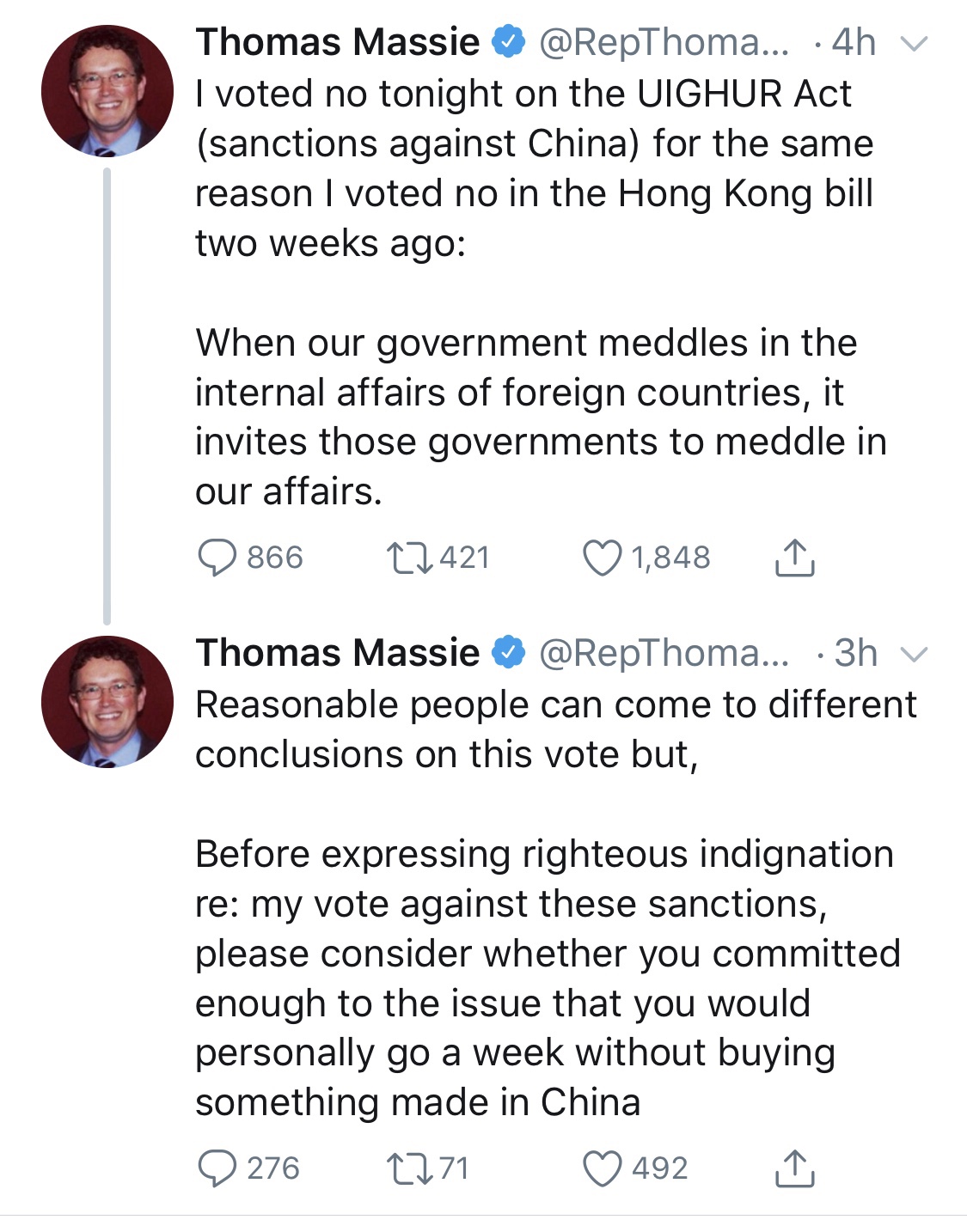
Religious Liberty, Uighur Muslims and You.

The issue of religious liberty is an issue of concern for us all. If a person or group is singled-out or mistreated because of their religion, then any other group can be singled-out as well. Fundamental religious freedom is a bulwark of what it means to be free in the United States of America. The persecution of a peoples because of their ethnicity and religion is a fundamental offense on basic human rights and any culture with a conscience cannot be silent. Those who do not voice their opposition to the mistreatment of others, will eventually have no one to speak for them when they are mistreated.

Right now, China is believed to be detaining around a million Uighur Muslims in camps in Xinjiang. This detention is said to be China’s fight against Islamic extremism. Secretary of State Mike Pompeo condemned China’s treatment of the Uighurs earlier in the year. Yesterday, December 5, 2019, the United States House of Representatives voted almost unanimously to pass the Uighur Act of 2019. This Act condemns gross human rights violations linked to Beijing’s crackdown on the Uighurs. The bill also encourages President Trump to sanction Chinese officials who are said to be behind the actions taken against the Uighurs.

As a resident of the Kentucky’s 4th Congressional District, it is the “almost” in the support for the Uighur Act that is concerning to me. Congressman Thomas Massie is the lone Nay vote against the Act. It is the Congressman’s rational in voting against this Act that is most concerning to me. He voiced his reasoning on his Twitter account. His reasoning can be summarized in two points: The United States should mind our own business and we must not endanger our relationship with China unless we are willing to forfeit our use of the products they produce.

His reasoning is horrifying to me. First, his ideology lends itself to the same mindset that has enabled countless atrocities around the world. If we claim at any level to be moral people, we cannot be silent when we see such injustices. As a Christian, if I want religious freedom for Christianity, I must defend it for other religions. Second, as a resident of the congressional district that Massie represents, I find any references from him about economic issues almost laughable. Eastern Kentucky is an economically depressed area and to my knowledge he has done nothing to help spur economic change to the area he represents. The greater issue is his reasoning which puts a price on human rights. We can never be so beholden to our conveniences that we cannot protect the rights of our fellow humans.

Would you be willing to express your concern and opposition to Congressman Massie, his Nay vote, and his reasoning? Would you contact his Washington, DC office? (202) 225-3465

Serving Those Who Serve

A hero is a label that gets thrown around often but is appropriate for those who willingly put themselves into harm’s way. These are people who serve to protect their countrymen. Even in the subtleties, these are not men of retreat. The American flag on their right shoulder is leading—stars first, it is pressing forward, if necessary into battle. These are people who willingly enlist in wartime, these are men and women who come to the aid of their country. Here are some ways that we can serve them:

Honor Their Service by the Way You Live

The soldier and the citizen are in a partnership. The seven basic values of the United States Army are: Loyalty, Duty, Respect, Selfless Service, Honor, Integrity and Personal Courage. One soldier said in reference to these values, “If I represent the nation, the nation should embody those characteristics.” Since the solider represents the nation, and he lives by these values, the nation should also strive for these values. A soldier swears an oath to protect the Constitution, the ideals of our nation, therefore, every citizen has a responsibility to honor that partnership with his life.

Be Proactive in Reaching-Out

When a service member is deployed, he or she leaves behind a family and familiarity. Don’t just be willing to help, do something to help. When that soldier deploys, there are jobs at home that still need to be completed. Ask family members specific jobs that need done. Offer free childcare. Responsibilities may drastically change during deployment. A spouse may need help in home management responsibilities. Ask and pray for specific needs, and follow-up with family. Be willing to listen as family members share. You don’t have to have the answers to listen.

Reach-out to the soldier. Deployment can take a soldier to an unfamiliar place, communication from home connects him to something familiar. Send a care package and fill it with the soldier’s favorite items, especially those things that are unique to his community. Have your small group or Sunday School class adopt a soldier and make a specific effort to care for his or her family, maintain regular contact and specifically pray for the soldier. One soldier said, “Soldiers and spouses both tend to have idealistic images of what life after deployment is going to be like.” A church small group or Sunday School class can help in the transition home by being willing to pro-actively help with meals, childcare and routine home maintenance.

Listen

Coming home from deployment can require major adjustment, be willing to listen. The soldier may or may not want to share his experiences, be a real friend and listen without prying. Paul writes, “Bear one another’s burdens and thereby fulfill the law of Christ.” (Galatians 6:2). The places and those involved may be mostly foreign to you, submit yourself to the leadership of the Holy Spirit and be a friend who listens.

Express Sincere Gratitude

Three service members were interviewed in preparing this article. These men had served as both enlisted and officers. These men had served in combat in multiple wars, and yet all of them were reluctant to even be recognized for the part that they played in protecting the United States of America. When a soldier returns home from foreign soil, he is changed. As one of those interview said, “I’m not a broken individual, but I interpret society much differently.” A soldier makes it possible for the United States government to fulfill its God ordained role in protecting its citizens, honor their service with sincere gratitude.

Bully as Leader

The word, “bullying” takes me back to the childhood idiom, “Sticks and stones may break my bones, but words will never hurt me.” Although a way to help children to not get bogged down by the hurtful comments of others, the lesson of that idiom never really seemed true. Bullying hurt as a child and it hurts even more as an adult. In a culture that is more connected than ever, bullying seems to be more prevalent than ever. Bullying could once be avoided simply by going home now is unavoidable because of the interconnectedness of social media. In their Resolution on Bullying Among Children and Youth, the American Psychological Association, summarizes bullying as, “commonly characterized as aggressive behavior that (a) is intended to cause distress or harm, (b) involves an imbalance of power or strength between the aggressor and the victim, and (c) commonly occurs repeatedly over time.” This short summarization reveals the root contradiction of a bully as a leader.

A bully is one who has power over the one being bullied. A bully uses his power in order to victimize others. A bully leverages his imbalance of power to force his will upon another. A leader is in a place of influence. A leader holds her place of influence as a steward, existing for the benefit of others. A leader recognizes that her agenda is accomplished through the willful participation and contribution of others. A leader knows that which is to be accomplished is for the benefit of all. The way a bully and a leader functions is almost directly opposite.

How a Bully Functions

   As already stated, a bully depends on his position of power in order to do harm and exert his will upon another. Sandra Harris and Garth F. Petrie write, “Not all bullying is obvious, as hitting or verbal teasing are. Sometimes bullying is subtle, such as consistently excluding victims from groups and activities. This type of bullying is particularly insidious, because often victims do not realize that they are being bullied.” A bully uses his position to accomplish his will and to exclude and victimize anyone in his way.

The power of a bully is also seen in his peer popularity. A bully knows how to work the crowd to garner their goodwill, this is how they often gain the approval and even endorsement of those with even more influence. A bully uses his place of influence, which itself is attracting, to garner the participation of others. Others attracted by the popularity of the bully, and not wanting to be victimized, only make the imbalance of power greater. Others become complicit in the actions of the bully before they even know it, and this demonstrates its “insidious” nature. The bully will subtly and at times not so subtly destroy another all in the watchful eye of onlookers. A bully uses others to make himself even more powerful.

How a Leader Functions

   A leader also has a position of power, but a leader recognizes that position as a stewardship. James MacGregor Burns writes, “Instead of exerting power over people, transforming leaders champion and inspire followers.” A leader recognizes the importance of the willful participation of others. A genuine leader does not view people as merely a commodity to accomplish his will but as someone of value who also will benefit from the better future achieved through their participation.

Leadership is accomplished not through viewing people as a commodity or a means to an end but is accomplished through relationship. James M. Kouzes and Barry Z. Posner write, “Success in leading will be wholly dependent upon the capacity to build and sustain their human relationships that enable people to get extraordinary things done on a regular basis.” Leadership comes through wielding the influence of inspiration for the benefit others not by the pressure of one. It is the ongoing depth in relationship that fuels the participation of others.

Leadership is carried out for the benefit of others. Kouzes and Posner write of a leader, “They connect others to what is most meaningful in a shared vision. They lift people to higher levels of motivation and morality, and continuously reinforce that they can make a difference in the world.” A leader does not subvert morality but rather works from morality and raises others to a higher level of morality. A leader doesn’t use people, but builds people for the benefit of all.

Conclusion

   Bullying and leadership could not be more different. The distinction between the two are essentially important in being a healthy leader, follower, and in having a healthy organization. Accomplishments can take place with a bully at the helm, but this is often at the detriment of others and ultimately the organization. Leadership requires time for relationships to be built and skill to help others benefit in moving together, but it is wroth the effort.

Things I Learned by Preaching Through a Long Book of the Bible

I found these notes on my phone that I had jotted down after completed preaching through a longer book of the Bible. As a Pastor, it is my calling, to the best of my ability to teach the Bible in order to equip those entrusted to my care. It’s difficult to prepare people when they become bored with the subject matter. This is going to be a natural challenge even to the best preacher. The following points are a few things that I learned from preaching through the book of Acts:

⁃ God inspired the writing of books, even long ones for a reason. The book of Acts isn’t just the first history book of the church but it also, at length, addresses her purpose and displays that purpose in action.

⁃ Somewhere there is an intersection between the attention of men and women and your ability to hold that attention on a given subject. I don’t always do this well. There were certain sections that I needed to summarize in order to move forward at a pace that kept this balance.

⁃ As much as it was a disciple for me to preach through a long book, it is also a disciple for people to listen through a long book. I believe God grew me as a preacher as we moved through Acts and I believe He grew those whom I serve as I preached through Acts.

⁃ It was helpful to periodically take breaks from the series. This enabled me to address pressing needs of our church and allow both the church and myself to return to the series with renewed interest.

⁃ I still struggle with preaching long passages. I was not able to address many details in the text, but that’s ok. It’s ok, not because the details don’t matter but because someday, I will return to the text. Also, as I grow, as the congregation grows, I will understand and the church will understand the text more deeply.

⁃ I am more confident than ever that the Chief Shepherd shepherds His sheep through the expositional preaching of His Word. I am the Under Shepherd. I don’t have all of the answers to life’s problems or the wisdom to lead His flock but He does and He is so kind and faithful to tend to His flock.

⁃ Different genres of Scripture require a different approach in preparation and preaching. Acts is largely Narrative by which God reveals historical events and God reveals Himself. In Narrative broader strokes are often required as opposed to Epistles which require at times greater attention to details such as literary devices and language.

– The acts of the Holy Spirit as He moved the gospel to the nations through the church is the story of Acts. Although there is a constant tension in Principle-izing the text in application, the story given by the Holy Spirit is that given by God through the text not man-centered, self-help principles.

Even as I look over these lessons, I recognize that they reflect my inadequacies as a preacher. I hope that if you are a preacher reading these lessons that you find them helpful in your own growth. If you are reading these lessons as one who has listened as I preached through the book of Acts, I hope that it helped you in your walk with the Lord and thank you for your graciousness as I learn to serve you and ultimately the Lord more faithfully.

Create a free website or blog at WordPress.com.

Up ↑